

Functions of AI Agents
AI agents are intelligent software programs that can perform tasks without constant human supervision. They use algorithms, data, and machine learning to understand and solve problems. Here are some common functions of AI agents:
- Automation: AI agents handle repetitive tasks like data entry, scheduling, or customer support, freeing up human resources for more strategic work.
- Decision-Making: They analyse large datasets to recommend actions or solutions based on patterns and trends.
- Personalisation: AI agents customise user experiences by suggesting content, products, or services tailored to individual preferences.
- Monitoring and Reporting: These agents can track system performance, identify anomalies, and generate reports for analysis.
- Communication: AI agents facilitate interactions through chatbots, voice assistants, and virtual support systems.
Types of AI Agents
AI agents are categorised based on their complexity and level of intelligence. The main types include:
- Simple Reflex Agents: These agents respond to specific inputs using pre-defined rules. They are used in systems like automated thermostats and vending machines.
- Model-Based Agents: They maintain an internal understanding of their environment to make informed decisions. Navigation apps and robotic vacuum cleaners are examples.
- Goal-Based Agents: These agents work towards achieving defined objectives by analysing multiple possibilities and choosing the best action.
- Utility-Based Agents: They prioritise actions based on utility values, ensuring the most beneficial outcomes. Self-driving cars and recommendation systems often use this model.
- Learning Agents: These agents learn and improve from experience using techniques like machine learning and reinforcement learning.
How Does AI Agents Work?
AI agents operate through a continuous cycle of perception, reasoning, and action. This process mimics human decision-making but happens at machine speeds, often processing thousands of inputs simultaneously.
The perception phase involves gathering information from the environment. Depending on the agent’s design, this might include text inputs, database records, sensor readings, images, or audio signals. Modern agents often integrate multiple data sources, combining structured and unstructured information. For example, a customer service agent might simultaneously access purchase history, previous support tickets, and the customer’s current message to build a complete picture of the situation.
During reasoning, the agent interprets this information through various computational methods. Simple agents apply preset rules, while sophisticated ones use machine learning models trained on thousands or millions of examples. This training enables pattern recognition that powers the agent’s decision-making. Neural networks—mathematical systems inspired by human brains—often handle complex reasoning tasks by processing information through interconnected layers that extract increasingly abstract features.
The action phase executes the agent’s decisions. Actions vary tremendously based on the agent’s purpose. A text-based agent might generate appropriate responses, while industrial agents control robotic systems or adjust manufacturing parameters. Customer-facing agents often combine information retrieval with natural language generation to produce relevant, contextual answers that sound conversational rather than mechanical.
Behind these processes lies extensive infrastructure. The agent’s knowledge base contains facts, rules, and previous experiences that inform decisions. Language models provide an understanding of human communication. Planning modules map potential paths toward goals. Learning systems continuously update the agent’s approaches based on success or failure.
Modern agents increasingly rely on reinforcement learning—a technique where agents receive positive or negative feedback based on their actions. This approach allows systems to discover effective strategies through trial and error, similar to how humans learn complex skills. Agents receiving consistent feedback gradually optimise their behaviour, becoming more effective over time.
Key Benefits of AI Agents
Businesses implementing AI agents gain numerous competitive advantages that directly impact both operational efficiency and customer satisfaction. These benefits extend across departments and functions, delivering measurable improvements in multiple areas.
- Cost Reduction: Represents the most immediate benefit for many organizations. AI agents handle routine inquiries and tasks at a fraction of the expense of human staff. Customer service departments typically report 30–40% cost reductions after deploying well-designed agents. Unlike human employees, these systems scale instantly during peak periods without additional hiring or training costs.
- Operational Consistency: Improves significantly with AI agents. Human workers inevitably show performance variations based on fatigue, mood, or individual differences in training. Agents deliver identical service quality regardless of time, workload, or circumstance. This consistency builds customer trust and reduces errors in critical processes.
- 24/7 Availability: Transforms customer expectations. Modern consumers increasingly demand immediate service regardless of business hours. AI agents provide continuous support without overtime costs or scheduling headaches. Companies report substantial increases in customer satisfaction metrics after implementing round-the-clock support through AI systems.
- Data-Driven Insights: Emerge naturally from agent operations. Every interaction generates valuable information about customer needs, process bottlenecks, and emerging trends. These insights help businesses anticipate problems, identify opportunities, and refine offerings based on actual user behaviour rather than assumptions.
- Scalability: Becomes dramatically simpler with AI agents. Traditional growth requires proportional increases in staffing, training, and management oversight. Agent-based systems handle growing volumes with minimal incremental costs. Organizations can expand into new markets or launch new products without the traditional ramp-up period for support infrastructure.
- Employee Satisfaction: Improves when repetitive tasks shift to automated systems. Staff members spend more time on challenging, rewarding work that machines can’t handle. Companies report reduced turnover and increased engagement when AI agents manage routine responsibilities. The technology becomes a partner rather than a replacement, enhancing human capabilities rather than diminishing them.
- Process Acceleration: Delivers competitive advantages. AI agents process information and make decisions in milliseconds, eliminating bottlenecks in approval workflows, document processing, and information retrieval. This speed advantage compounds across operations, reducing project timelines and improving responsiveness to market changes.
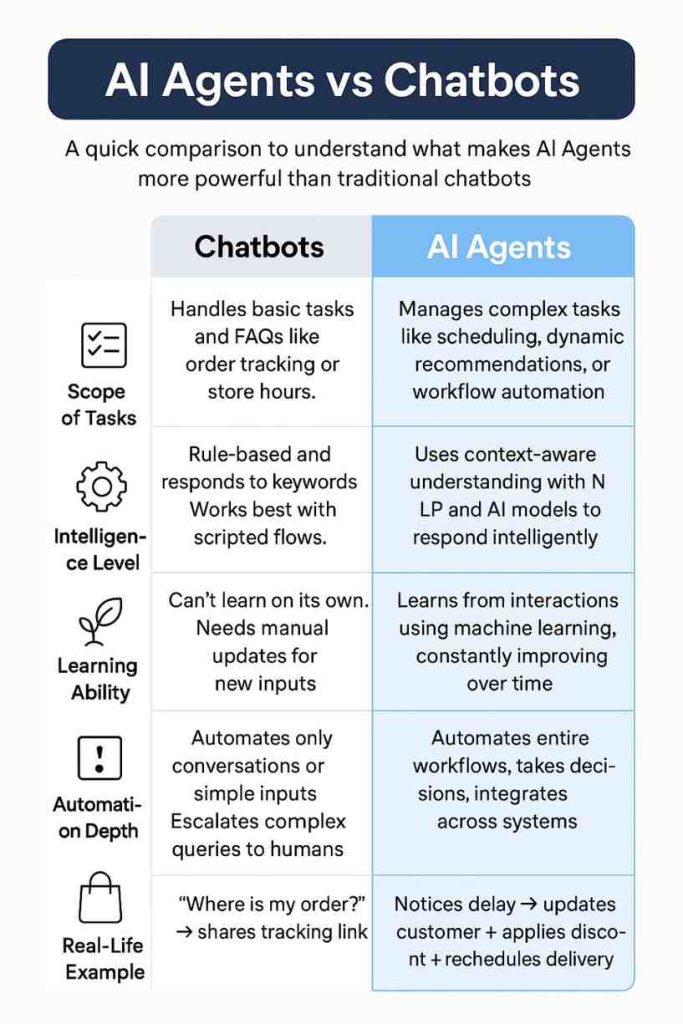
How AutoChat AI Agent Can Help Your Business?
AutoChat AI Agent offers advanced solutions for better operations in businesses. Here’s how AutoChat can benefit your organisation:
- Customer Support: AutoChat handles customer queries efficiently, providing instant responses and improving satisfaction.
- Lead Generation: It engages potential leads, captures relevant information, and qualifies prospects.
- Task Automation: From scheduling appointments to sending notifications, AutoChat reduces manual work.
- Data Analysis: Gain actionable insights through data collected and analysed by the AI agent.
- Multi-Channel Support: AutoChat focuses on WhatsApp automation, website handoff, and structured customer interactions.
AI agents are reshaping the business landscape by offering smarter, faster, and more reliable solutions. Whether it’s improving customer service, automating workflows, or generating insights, integrating the best AI agent, AutoChat, can significantly enhance your business performance.