
Shopping online just got easier. WhatsApp is no longer just for messaging friends. Now, it can also help you shop.
Imagine finding, choosing, and buying products through a simple chat. No need to download another app or visit a website. This is what WhatsApp chatbots bring to online stores today.
What is a WhatsApp Chatbot for E-commerce?
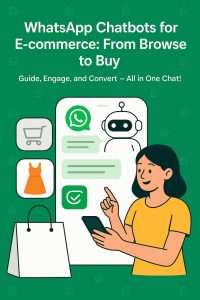
A WhatsApp chatbot is like a digital shop assistant that works inside the WhatsApp app. It talks to your customers, answers their questions, and helps them buy your products.
These chatbots use the same WhatsApp that billions of people already have on their phones. This makes shopping incredibly simple for customers. They chat with your store just like they chat with friends.
The smart part is that these bots handle customer questions automatically. They work 24 hours a day without getting tired. When someone asks about a product, the bot answers right away.
Features of WhatsApp Chatbots for E-commerce
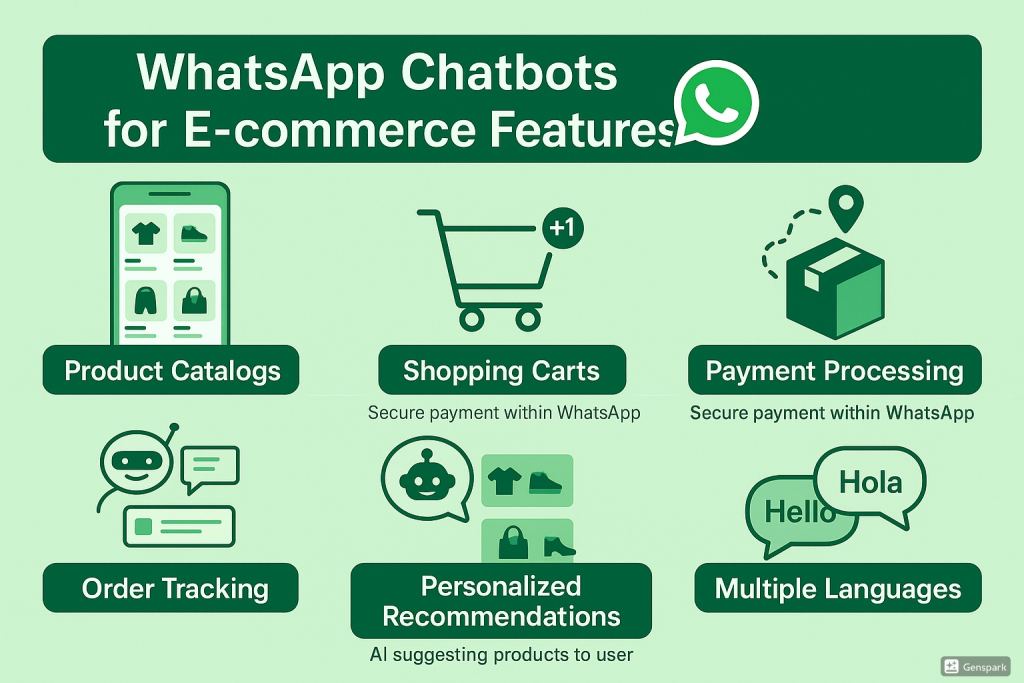
WhatsApp chatbots come packed with tools that make online selling easier:
- Product Catalogs: Bots show customers your products right in the chat. Pictures, prices, descriptions – all there in one place.
- Shopping Carts: Customers can add items they like and keep shopping. The bot remembers everything they’ve chosen.
- Payment Processing: Many bots let customers pay without leaving WhatsApp. This means fewer abandoned carts.
- Order Tracking: After buying, customers can ask the bot, “Where’s my order?” and get instant updates.
- Personalized Recommendations: The bot remembers what customers liked before and suggests similar items.
- Automatic Notifications: Bots send messages about sales, restocked items, or shipping updates.
- Multiple Languages: Good bots speak the customer’s language, making shopping comfortable for everyone.
Types of Chatbots & Their Role in E-commerce
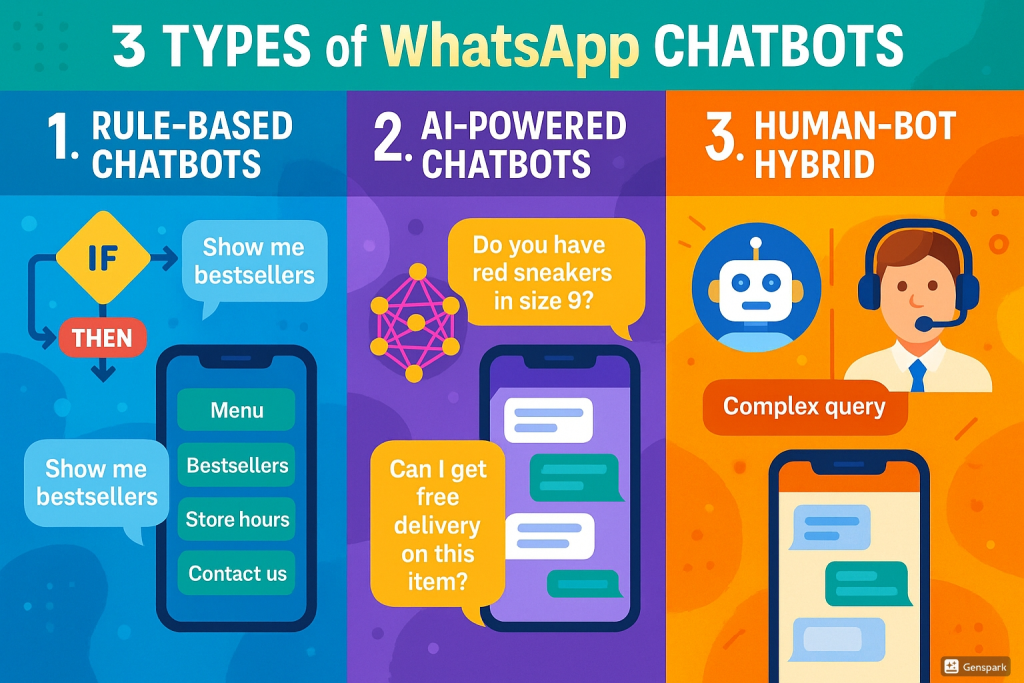
Not all chatbots are the same. They range from simple to sophisticated:
- Rule-Based Bots: These follow set scripts and respond to specific commands. They’re good for basic tasks like showing bestsellers or store hours. Think of them as digital menu systems.
- AI-Powered Bots: These understand natural language. Customers can type normal questions like “Do you have red shoes in size 9?” and the bot understands. They learn from each conversation and get smarter over time.
- Human-bot hybrid: These start as automated chats but smoothly transfer to human agents for complex questions. Customers hardly notice the switch.
In e-commerce, these bots play crucial roles:
- They answer common questions instantly
- They guide customers through products
- They complete sales without human help
- They follow up after purchase
- They bring back customers who abandoned carts
Benefits of WhatsApp Chatbots for E-commerce
The advantages are clear for both stores and shoppers:
For Store Owners:
- Wider Reach: WhatsApp has over 2 billion users worldwide. That’s a massive potential audience.
- Higher Conversion Rates: When shopping is this easy, more browsers become buyers. Some stores report 3–4 times more sales through WhatsApp compared to websites.
- Lower Costs: One bot can handle hundreds of customers at once. This cuts down on customer service expenses.
- Better Data: Every chat gives you insights about what customers want and how they talk about products.
- 24/7 Availability: Your store never closes, even when you’re sleeping.
For Customers:
- Convenience: Shop from the app they already use daily.
- Speed: No page loading or navigating complex websites.
- Personalized Experience: The bot remembers their preferences.
- No App Switching: Everything happens in one place — browsing, questions, payment.
- Human-like Interaction: Good bots make shopping feel more like talking to a helpful store clerk.
Successful Use Cases
- Sephora: Uses WhatsApp bots to let customers book makeup consultations. After appointments, the bot follows up with product recommendations based on what the customer liked. This personal touch increased their follow-up sales by 25%.
- Adidas: Created a WhatsApp bot for its limited-edition shoes. Fans could chat with the bot to get early access. The campaign reached 2 million people and sold out products faster than any previous launch.
- H&M: Helps shoppers find specific clothing items. Customers can send a picture of an outfit they like, and the bot finds similar items in H&M’s catalog. This feature reduced the time customers spend searching for products.
- Pizza Hut: Lets customers build custom pizzas through WhatsApp chat. The bot remembers past orders, making reordering as simple as typing “usual pizza please.” Their WhatsApp orders are now 30% of their total delivery business.
- Booking.com: Uses a WhatsApp bot to handle travel questions and send booking confirmations. It also sends room photos, check-in instructions, and local tips. Travelers love having all trip info in their WhatsApp, ready when needed.
Key Elements to Implement WhatsApp Chatbots for E-commerce
Ready to build your own? Focus on these essentials:
- Get a WhatsApp Business API: This is your official connection to WhatsApp. You’ll need to apply through a WhatsApp WhatsApp API provider.
- Choose the Right Chatbot Platform: Look for one that specializes in e-commerce and integrates with your existing systems. Some good options include Landbot, Gallabox, and ManyChat.
- Design Simple Conversation Flows: Map out the most common paths customers take. Make sure the bot can handle questions about products, prices, shipping, and returns.
- Connect Your Product Catalog: Sync your inventory so the bot always shows current products and prices.
- Add Payment Options: Integrate secure payment methods that work in WhatsApp.
- Plan for Human Backup: Set rules for when a real person should take over the conversation.
- Start with Must-Have Features: Begin with catalog browsing, cart functions, and ordering. Add more complex features later.
- Test Thoroughly: Try breaking your bot by asking unusual questions. Fix the problems before launching.
- Train Your Bot Continuously: Review chat logs to find where customers get confused. Update your bot’s responses regularly.
- Follow WhatsApp’s Rules: Respect message limits and content policies to avoid getting blocked.
Implementation Steps
- Define Your Goals: What do you want the chatbot to achieve? More sales? Better customer service? Clear returns?
- Choose Your Tools: Select platforms that match your technical skills and budget.
- Create Your Bot Personality: Decide how your bot should talk. Friendly? Professional? Casual?
- Build Your Flows: Design conversation paths for browsing products, asking questions, and completing purchases.
- Integrate Systems: Connect your inventory, CRM, and payment processors.
- Test with Real Users: Have actual customers try your bot before the full launch.
- Launch Gradually: Start with a small customer group, then expand.
- Measure Results: Track sales, conversation completion rates, and customer satisfaction.
- Improve Constantly: Use data to make your bot better every week.
Common Challenges and Solutions
- Challenge: Customers asking complex questions.
Solution: Create “fallback” responses and smooth handoffs to human agents. - Challenge: Cart abandonment in the middle of chat.
Solution: Set up reminder messages that bring customers back to finish shopping. - Challenge: Keeping product information updated.
Solution: Use API connections that automatically sync your inventory with the chatbot. - Challenge: Making the bot sound natural.
Solution: Study your actual customer service chats and mimic that language in your bot. - Challenge: Handling multiple languages.
Solution: Start with your primary market language, then add others based on demand.
The Future of WhatsApp Shopping
WhatsApp shopping is still growing. Here’s what’s coming next:
- Virtual Try-Ons: Bots that let customers “try” products using AR technology.
- Voice Shopping: Talking to bots instead of typing.
- AI Personal Shoppers: Bots that learn your style and find perfect products for you.
- Social Shopping: Group chats where friends shop together with bot assistance.
- Seamless Multi-Channel Experience: Start shopping on Instagram, continue on WhatsApp, and finish on your website.
Make Shopping Easier with AutoChat
Want to transform your online store with a WhatsApp chatbot? AutoChat makes it simple.
AutoChat builds powerful WhatsApp chatbots specifically designed for e-commerce. Our platform connects directly to your product catalog, payment systems, and shipping tools.
With AutoChat, you can:
- Launch your WhatsApp store in days, not months
- Increase sales by 40% on average
- Handle thousands of customers simultaneously
- Get detailed analytics on shopping behavior
- Make updates yourself without coding knowledge
We’ve helped hundreds of online stores grow their sales through WhatsApp. Our clients typically see ROI within the first month.
Ready to let your customers shop through chat? Visit createautochat.com today for a free demo. Turn your WhatsApp into your best-performing sales channel.

As a BCA graduate with a passion for technology and innovation, committed to leveraging technical knowledge to craft insightful and engaging content that resonates with a wide audience.